.png)
What This Valley Could Be

By Humberto Rodriguez
Yakima Valley, WA
Dumping Ground: The Series | The Reporting Behind the Documentary Part Five of Five
This piece is different from the four that came before it.
Parts One through Four did the reporting. They sourced the data, documented the process, named the conflicts of interest, corrected the record when I got things wrong, and tried to tell the complete truth about something complicated happening in a place I love.
This piece does something else.
This piece is just me. A neighbor who started asking questions a week and a half ago and could not stop. Someone who has spent the last two weeks in more conversations, public and private, with farmers and farmworkers and attorneys and elected officials and community advocates and people I had never met before, than he expected when he posted a short video on Facebook and watched it travel eighty thousand times across a valley that was clearly waiting for someone to say out loud what everyone already knew.
I am not a journalist. I said that in Part One and I mean it still. What I am is someone who lives here. Someone who cares what this place looks like when we hand it to the next generation. Someone who believes, after everything I have seen and heard and read and felt in the last two weeks, that this valley is capable of something extraordinary if we can just get out of our own way long enough to try.
What I Found
I found that farmers and farmworkers have more in common than anyone who profits from their division wants them to know.
I found that the people speaking the loudest in this debate are often not the people most affected by it. The people most affected, the farmer who has watched his neighbors sell off their herds one by one, the farmworker family drinking water from a well they are not sure is safe, the resident who found out about a $120 million industrial facility going up next to their home from a filmmaker's Facebook video instead of from the city that approved it, those people are exhausted. They are not keyboard warriors. They are people trying to get through the week.
I found that when you actually sit down with someone from the other side of this debate, not to argue, not to score points, but to listen, you almost always find someone who loves this valley. Who wants it to survive. Who is scared that it will not. Who has been told so many times that the person across the table is their enemy that they have started to believe it even though nothing in their actual lived experience supports that conclusion.
I found that the loudest voices in any community controversy are rarely the most representative ones. There is a small group of people on every side of every issue whose primary contribution is noise. They criticize. They point out flaws. They dig up struggles and mistakes and use them as weapons against anyone trying to do something. They do this under the mask of informing the community. But most people see through it. Most people are tired of it. Most people want something different and do not know where to find it. I found that most everyone does.
What Happened To Me
I want to be honest about something personal because this series has been built on honesty and I am not going to stop now.

While I was doing this work, while I was sourcing articles and correcting mistakes and having conversations with farmers and attorneys and elected officials and community advocates, someone went into my past and pulled out my struggles. My hardest seasons. Things that have nothing to do with a proposed industrial facility in Sunnyside and everything to do with the fact that I am a human being who has not lived a perfect life. They went back into things that had already been made public about a year ago and chose to resurface them now. Not because anything had changed. But because I was asking questions they did not want asked.
I want to say something about that clearly and without bitterness.
My struggles are mine. I have lived them. I am living with them. I am working through them. I have not run from them. I have gotten up every single time. And not one of them disqualifies me from caring about this valley or from telling the truth about what is happening to it.
What happened to me happens to people of all walks of life who raise their voice about something that matters. You speak up. You bring attention to something important. And someone, not everyone, not even most people, but someone, decides that the right response is not to address what you said but to remind you of your worst moments.
We chose to stay focused.
We chose to correct our mistakes and keep going. We chose to lead with more understanding than we were shown. We chose to believe that the work matters more than the noise around it. And I believe, I genuinely believe, that the voices trying to tear down anyone who asks valid questions will fade. But the work that makes a difference will stay.
What This Valley Actually Is
This valley feeds America.
Not metaphorically. Literally. The apples, the hops, the wine grapes, the cherries, the asparagus, the dairy. The food on tables across this country, a significant portion of it came from here. From these fields. From these farms. From the hands of the people who live in these communities.
The farmer who has been here for decades building something with his family. The farmworker family that has been in this valley for three generations. The retired nurse who has spent seventeen years documenting what is happening to the air and water. The first Latina Mayor of a city that is finally being represented by someone who looks like most of its residents. The young attorney who came back home because home needed him. The community members who stood in a hallway for three hours because there was no room left inside.
These are not enemies. These are neighbors. These are the people who built this place.
And somewhere along the line someone convinced them to choose sides. You associate with them you are the enemy. You believe in that you are the enemy. You ask that question you are the enemy. And while everyone was busy choosing sides and defending their corners the decisions about what this valley looks like were being made above all of them by people who will not live with the consequences.
That ends when we decide it ends.
What I Believe
I believe small family farms are essential. Not as a romantic idea. As an economic and community reality. This valley needs them. The people who work on them need them. The communities built around them need them. Every small family farm that closes takes something with it that cannot be replaced by a corporate operation that answers to shareholders somewhere else.
I believe the farmworker families of this valley deserve clean water and clean air and the right to know what is being built next to their homes in a language they can read. Not as a political position. As a basic standard of human dignity that should not require a fight to obtain.
I believe both of those things simultaneously and I refuse to choose between them.
I'll say what I've said before, I believe that the laws governing farming in this state were largely written by people who have never watched a herd get sick overnight. Who have never made payroll after a bad year. Who have never felt the weight of knowing that everything your family built over decades could disappear because of decisions made in Olympia by people who have never set foot on your land. Those laws need to be pushed back on, not by farmers alone and not by environmental groups alone but by everyone in this valley who understands that unrealistic regulations do not protect communities. They just accelerate the closures that hurt everyone.
I believe that the organizations doing genuine work in this valley, on all sides, deserve to be understood for what they actually do rather than caricatured by the loudest voices on the opposing side. ELLA organizes communities. Friends of Toppenish Creek fights for clean water. Save Family Farming advocates for farmers. None of them are the enemy. All of them are responding to real problems with the tools they have. The question is whether those tools are enough and whether there is something missing in the middle.
I believe there is something missing in the middle.
What Could Be
Imagine a table.
Not a metaphorical table. A real one. In a room somewhere in the Lower Yakima Valley. With farmers sitting across from farmworkers. With environmental advocates sitting next to dairy operators. With elected officials who are actually accountable to the people in that room. With young people from this valley who are trying to decide whether to stay or go. With the community members who testified in that hallway because there was no room inside.
No outside company at that table. No Oregon corporation deciding what our community looks like. No politicians from Olympia who have never driven down Sunnyside Mabton Road. Just the people who live here. Working out, slowly, imperfectly, with disagreement and frustration and the occasional breakthrough, what this place should look like.
That table does not exist yet.
It should.
We do not have to agree on everything. We do not have to agree on anything. But we should give each other room at the table. We should listen to understand and not just listen to respond. We should be willing to have our beliefs challenged without feeling personally attacked. We should be willing to say I got that wrong and keep going.
Because something else is happening while we fight each other.
The people above us are moving fast. The decisions are being made. The permits are being processed. The money is being committed. The infrastructure is being built. And every hour we spend pointing at each other is an hour we are not spending on the questions that actually matter.
Who benefits from this deal and who absorbs the cost.
Who was asked and who was left out.
Who gets to decide what this valley looks like and whether that person has to live here afterward.
Those are the questions. And the only people who can answer them, the only people with the moral authority and the lived experience and the genuine stake in the outcome, are the people who call this valley home.
The Work That Begins Now
This series is five pieces. It took eleven days. It will have been read by people I have never met and people I have known my whole life. It will have made some people angry and some people hopeful and some people both at the same time.
It is not the end of anything. It is the beginning.
The documentary is next. And the documentary is not my story to tell alone. It belongs to this valley. It belongs to the farmer who has watched his neighbors disappear. To the farmworker whose children drink the water. To the Mayor who stood at a podium and said what needed to be said. To the retired nurse who has been saying it for seventeen years. To the young attorney who came home. To the community members who showed up even when nobody was listening.
If you have a story from this valley, if you are a farmer or a farmworker or a resident or a business owner or a young person trying to decide whether to stay, I want to hear from you. This documentary is being made independently. No network. No corporate sponsor. No outside agenda. Just a filmmaker from the Yakima Valley trying to tell the truth about a place he loves.
If you have photographs of your family in this valley, your farm, your history, your people, reach out.
If you have a camera and want to be part of telling this story, reach out.
If you simply have something to say that you have never had a place to say, reach out.
We do not have to agree on everything. We just have to show up.
This is our valley. This is our story. And no outside company, no organization, no politician, no keyboard warrior gets to tell it for us unless we let them.
We are great. We care. And we matter.
Now let's prove it.
Humberto Rodriguez is a filmmaker, podcaster, CEO, and lifelong resident of the Yakima Valley. He is the founder of United Family Center, a behavioral health agency serving the Yakima Valley, and the host of Behind the Scenes with Humberto Rodriguez. He is currently producing an independent documentary about the Sunnyside RNG project and its impact on the Lower Yakima Valley community.
To share your story, your photographs, or your interest in being part of the documentary contact Humberto at info@humbertor.com or 509.305.1542.
Dumping Ground: The Series is five-part investigative reporting from the Yakima Valley. Part Five of Five. An independent documentary is in production.
The Dumping Ground series:
Part One. Dumping Ground: How the Yakima Valley Became the Latest Sacrifice Zone for Renewable Energy
Part Two. When You Speak Up They Come For You: The Documented Reality of What Happens to Leaders of Color Who Refuse to Stay Quiet
Part Three. Both Sides of a Broken System: How Small Farmers and Latino Communities Are Losing the Same Fight
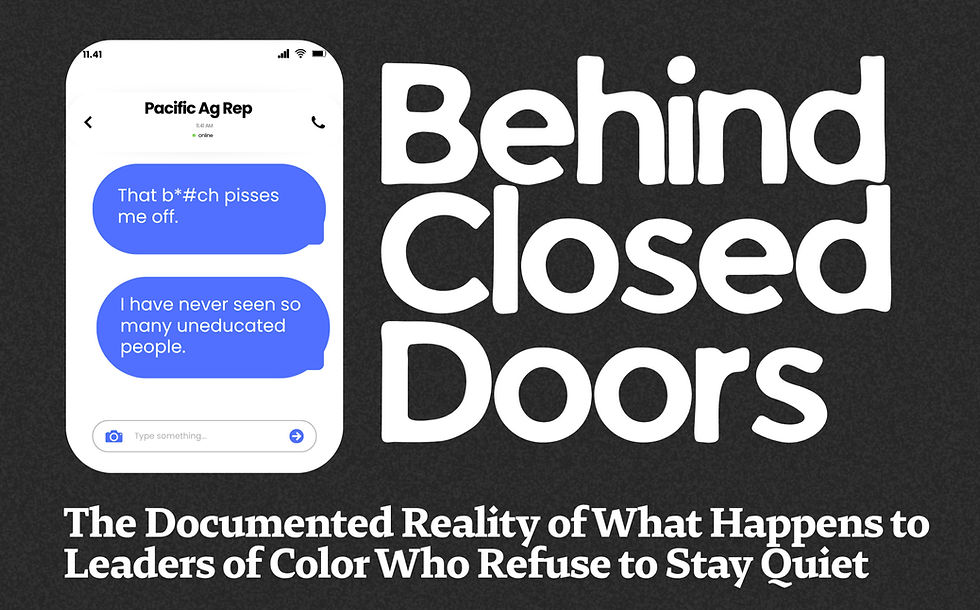
Part Four. Behind Closed Doors: What Pacific Ag Really Thinks About Your Community and Who This Deal Was Actually Built For
Part Five. What This Valley Could Be


Thank you Humberto for taking the time to speak up for our community. Together we can fight for the environment we all deserve.