.png)
Behind Closed Doors: What Pacific Ag Really ThinksAbout Your Community — And Who This Deal WasActually Built For

By Humberto Rodriguez
Sunnyside, WA
Dumping Ground: The Series — The Reporting Behind the Documentary
Part Four of Five
In Parts One through Three of this series we covered the facility, the broken process, the excluded community, and the system that has failed both Latino families and small family farmers in this valley while outside interests captured the value.
If you have not read those pieces, I encourage you to start there. What follows goes deeper into a single moment, a moment that was captured on camera during a public hearing on March 25th, 2026, and what it reveals about who this project was actually designed to serve.
The Room
Picture it.
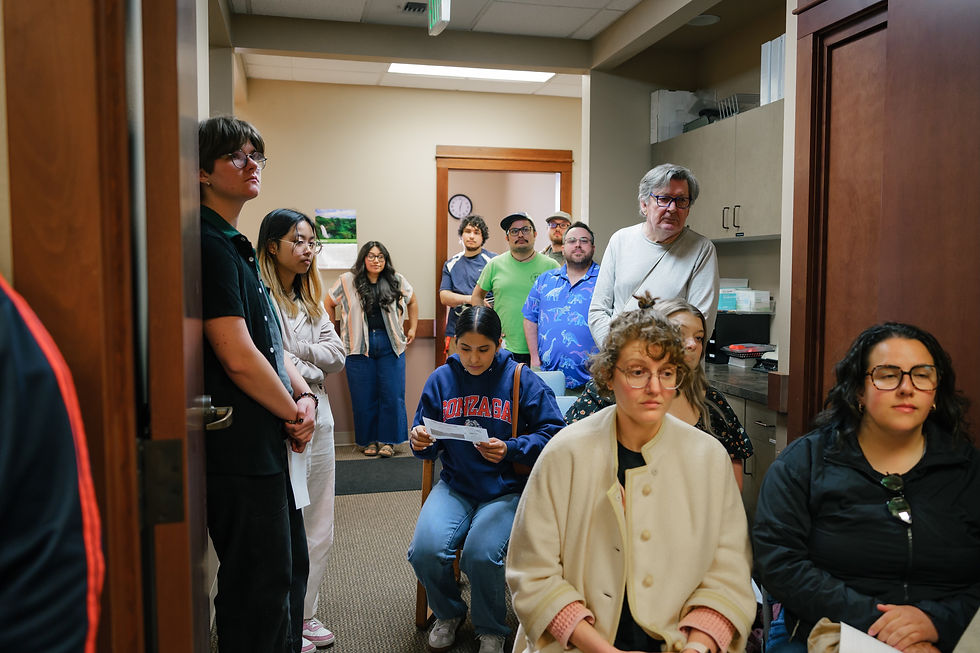
The Yakima Regional Clean Air Agency office in Yakima. Not Sunnyside, where the facility would be built, but Yakima, almost forty miles away. A Tuesday evening. The room is full beyond capacity. People stand in the hallway watching through the open door because there is nowhere left to sit.

For nearly three hours, community members walk to the microphone one by one and speak. A former water distribution specialist for the city of Sunnyside talks about the groundwater. A staff attorney from the Center for Food Safety testifies that the air data used to approve this project is outdated and that emissions from this facility may push particulate matter past the legal limit requiring federal oversight. Maria Fernandez of ELLA demands a full environmental impact statement. Resident after resident describes living a mile, a mile and a half from the proposed site. Lorena Avalos, a Sunnyside resident, says in Spanish, please listen to us and do not ignore us. The Mayor of Sunnyside, Vicky Frausto, stands at the podium and describes going door to door in 2023. Not one resident near the proposed site knew about the project. Most were monolingual Spanish speakers. She calls it systemic exclusion rooted in a pattern where communities of color are left out of decision making while they are expected to absorb the harm.
While all of this is happening Kipp Curtis, Pacific Ag Renewables Project Manager, the man whose job it is to build this facility in this community , is sitting in the back of the room.
Texting.
What He Said
Mayor Frausto published an eight-slide statement with photographs. The photos show Kipp Curtis holding his phone under the table during the hearing. In one image, the messages on the screen are visible. They are part of a group text with at least two other people, identified by the initials BL and ND, who Mayor Frausto noted are likely other Pacific Ag executives based on the company's public team directory.

The messages read:
"That bitch pisses me off."
"Now we're racist."
"I have never seen so many uneducated people throwing around facts. Also never seen so many men with purses."
These messages were sent while residents of Sunnyside were testifying about their health. About their children. About the air their families breathe and the water their families drink. About a project that would sit less than 100 yards from their homes.
This is not hearsay. This is not a rumor. These are photographs published by the sitting Mayor of Sunnyside with her name attached and her reputation behind them. She was in that room.
She saw it. She documented it.
The Contradiction That Defines This Project
We covered the approval process in Part One. We covered the systemic pattern in Part Two. We covered the economic divide between large and small farms in Part Three. But Part Four is about something more fundamental, the contradiction between what Pacific Ag says publicly and what its representative did privately when he believed the consequences were facing someone else.
Here is what Kipp Curtis, Pacific Ag Renewables Project Manager, said publicly in the Yakima Herald-Republic about the project:
Transparency is Pacific Ag's goal.
Here is what Kipp Curtis did privately while residents testified:
He described the Mayor as a bitch. He described the community as uneducated. He mocked the men in the room.
This is not a small contradiction. This is not a misunderstanding or a moment of frustration that should be dismissed. This is documented evidence of the private attitude of a company representative toward the community whose approval and trust he was simultaneously asking for.
And he was not alone. The messages went to at least two other people with Pacific Ag initials. Which means this contempt was shared. It was communicated. It was not an isolated private thought, it was a conversation.
What This Reveals About Who The Deal Was Actually Built For
Parts One through Three of this series documented the economics of this project. We covered it in the context of the community being left out. Now we need to examine it in a different light, because the text messages are not just an expression of personal contempt. They are a window into a corporate culture that never considered this community as a genuine stakeholder.
The research on digester economics is unambiguous on one point. These projects are not built for small farms. They are built around large ones.
A 2020 USDA Economic Research Service report found that large dairy operations, those with 1,000 or more head, realized positive net returns while farms with fewer than 500 head saw gross returns per hundredweight well below their average costs in every year between 2005 and 2018. Large farms have lower production costs. They survive downturns that bankrupt smaller operations. The scale advantage is not marginal, it is structural.
A Wisconsin study on anaerobic digester operations found something that should stop everyone in this valley cold. In 2022 Wisconsin had no small dairy farms producing RNG. The dairy farms producing renewable natural gas ranged from 1,700 to 9,100 cows per farm. The research concluded that companies running RNG facilities work with large dairy farms or clusters of large dairy farms near natural gas pipeline injection points.
Read that again. No small dairy farms producing RNG. The farms that benefit most from digester arrangements, that receive the manure payments, that reduce their waste management costs, that get the publicity of being environmental stewards, are the large operations. The small family farms that are disappearing from this valley , the ones watching their neighbors close one by one, the ones whose children want to farm but whose parents are not sure it is worth it, those farms are not the primary beneficiaries of this model.

The EPA's own documentation on dairy digester economics makes the same point. Hub and spoke business models, exactly the model Pacific Ag is proposing in Sunnyside, take advantage of economies of scale by using one large centralized facility for multiple farms. The centralized facility captures the value. The farms supply the raw material. One expert quoted in industry research noted plainly, unless you are able to get a project that is big enough to go the renewable natural gas route the economics just are not there.
Research in Hoard's Dairyman went further. It found that as dairy farms sign contractual agreements to supply manure to digesters they will be limited in how many cows they can cull and still meet their commitments. In other words, the digester arrangement does not just provide income to large farms. It creates dependency. The farm becomes tied to supplying manure at contracted volumes. The digester company, Pacific Ag in this case, sits at the center of that arrangement capturing the gas revenue while the farm is locked into a supply contract.
The more manure they process the more money they make. Not the farmer. The digester company.
The Small Farm Question Nobody Is Asking
In Part Three we asked what would have happened if the $22 million in public money committed to this project had gone directly to the farmers of this valley instead of to a centralized facility owned by an Oregon company.
Part Four adds a sharper version of that question.
Who among the Yakima Valley dairy farmers stands to benefit most from the Sunnyside RNG facility? And who stands to benefit least?
The answer the research gives us is this. The farms large enough to be anchor suppliers, the operations with 1,000 or more cows close enough to the facility to make manure transport economically viable , will receive the most meaningful revenue from this arrangement. A farm with 2,000 cows receiving $100 per cow annually gets $200,000 per year. In the context of a large operation, that number is significant.
A farm with 300 cows gets $30,000 per year. In the context of a small family operation carrying hundreds of thousands of dollars in compliance costs, equipment debt, labor expenses, and the volatility of milk prices, that number is not a lifeline. It is a footnote.

Meanwhile, the centralized facility in the middle of a residential community in Sunnyside, the one generating 90 to 115 truck trips per day, burning four industrial flares into already failing air, proposing 25 tanks each seven stories tall, that facility is projecting revenues based on processing 1.8 million MMBTUs of gas per year. At current market rates, that represents tens of millions of dollars annually in gas revenue injected into an interstate pipeline and sold to energy markets far from here.
The community gets 30 jobs and the trucks.
The small farmers get modest payments for their manure.
Pacific Ag gets the gas.
The Texts In That Context
Now go back to the texts.
Kipp Curtis sat in that room while the community his company is asking for permission to operate in testified about their health. And he texted contempt.
Not frustration. Not disagreement. Contempt.
That bitch pisses me off. I have never seen so many uneducated people. Also never seen so many men with purses.
The person he called a bitch is the first Latina Mayor of Sunnyside, a city that is majority Latino and that for generations made decisions about this community without anyone who looked like its residents at the table. The people he called uneducated were testifying with documented facts, legal citations, and public health data. The men with purses were community members who showed up to a formal regulatory hearing to exercise their right to participate in a process that was supposed to include them.
And here is what the research tells us about the corporate model behind those texts. This community was never the primary consideration for this project. The pipeline access was. The manure volume was. The low carbon fuel standard credits were. The federal grant eligibility was. Communities like Sunnyside, low income, predominantly Latino, with failing
air quality and contaminated water already, show up in the site selection calculus as places
where a permit can be obtained without the resistance that would arise elsewhere.
We documented that in Part Two. We documented it again in Part Three. The texts confirm what the research already told us.
The contempt was not a slip. It was consistent with a project that never genuinely considered the community it was built next to as a stakeholder worth informing, engaging, or respecting.
The Farmers In This Picture
I want to be direct about something because this series has been committed to the complete picture from the beginning.
Nothing in this analysis is an argument against dairy farming. Nothing here is a claim that every large dairy operation in the Yakima Valley shares Pacific Ag's corporate culture or Kipp Curtis's private attitudes. The research on digester economics does not make moral judgments about the farms that participate in these arrangements. Farmers making decisions about their own operations in a market that punishes small scale are not the villains of this story.
But the farmers, large and small, deserve to ask the same question the community deserves to ask.
Who is actually winning here?
The large operations with contractual manure supply agreements capture revenue and offload waste management costs. That is real. But they also become dependent suppliers to a corporate model that controls the gas, the pipeline, and the profit center. The small farms, the ones already struggling against regulations they cannot afford to comply with, against milk prices that do not cover costs, against an overtime law that squeezed them without the tax credits that other states provided, those farms do not receive enough from this arrangement to change their trajectory.
And the community that lives next to the facility receives the trucks, the flares, and the contempt of a project manager who texted his true feelings while they testified.
None of those people are Pacific Ag's primary consideration.The pipeline is.
What The Mayor Understood

When Vicky Frausto published those photos she was not just exposing one man's private messages. She was exposing the gap between the public language of transparency and the private reality of contempt.
That gap is the story of this project in miniature.
The public language says, we are creating jobs, reducing emissions, partnering with local farmers, committed to transparency.
The private reality says, that bitch pisses me off. These people are uneducated. Never seen
so many men with purses.
In between those two realities sits a community that was never informed in their own language. A city that committed $12 million before the environmental review was complete. An approval conducted by the official whose job was to bring this project to town. An appeal that was never processed. A doubling of the facility size that received no public attention.
Mayor Frausto understood all of that before the hearing. The texts confirmed it in a way no document could.
She published them anyway. Knowing what would happen next. Knowing that people would question the photos, minimize the messages, call it politics, say he was only talking about a few people.
She published them because the community deserved to know.
That is not politics. That is exactly what she was elected to do.
What Comes Next
The Yakima Regional Clean Air Agency has not yet issued a final decision on the air permit. The public comment period closed March 30th. The Department of Ecology has not weighed in. The conflict of interest in the SEPA process has not been formally adjudicated. At least one local attorney with deep roots in this community has reached out expressing interest in the legal dimensions of this case.
The story is not over.
And the question that Part Five will attempt to answer is not about what went wrong. That has been documented across four pieces and hundreds of pages of public record. The question Part Five asks is what this valley could look like if the decisions about its future were made by the people who actually live in it.
That question has not been asked seriously in a long time.
It is time.
A Note on Use and Republication
This article may be shared freely for non-commercial purposes with full credit to the author. If you are a publication interested in republishing this piece in full or in part please contact Humberto Rodriguez directly at info@humbertor.com or through humbertor.com. This work was produced independently with no organizational funding or affiliation. The reporting, research, and editorial decisions are solely those of the author.
Sources:
Statement of Mayor Vicky Frausto — YRCAA Public Hearing, March 25, 2026; published on
Vicky Frausto for Sunnyside City Council District 3 Facebook page — photographs of Kipp Curtis texting during hearing
Yakima Herald-Republic — YRCAA public hearing coverage, March 27, 2026; proposed biomethane plant coverage 2022-2026
USDA Economic Research Service — Scale Economies Provide Advantages to Large Dairy Farms (2020)
University of Wisconsin Extension — Wisconsin Anaerobic Digester Operations Dairy Industry Case Studies (2022)
US EPA AgStar Program — Anaerobic Digestion on Dairy Farms
Terrain Agricultural Consultants — Economic Sustainability of Dairy Digesters
Civil Eats — Are Dairy Digesters the Renewable Energy Answer or a False Solution to Climate Change? (2020)
Hoard's Dairyman — Energy Revenue Could Be a Game Changer for Dairy Farms (2021)Progressive Dairy / Ag Proud — Reducing Energy Use and Generating Renewable Energy Can Tip the Scale
Pacific Ag Renewables — Sunnyside RNG public documents, fact sheet, team directory at pacificag.com/our-team
Yakima Regional Clean Air Agency — draft Order of Approval, February 2026
Personal reporting and community observation, Yakima Valley, Washington, March 2026
Humberto Rodriguez is a small business owner, a lifelong resident of the Yakima Valley, and the host of Behind the Scenes with Humberto Rodriguez. He is currently directing a documentary about the Sunnyside RNG project and its impact on the Lower Yakima Valley community. He can be reached at info@humbertor.com or at 509-305-1542.


Comments