.png)
Dumping Ground: How the Yakima Valley Became the Latest Sacrifice Zone for Renewable Energy

Updated: Mar 30

By Humberto Rodriguez
Sunnyside. Washington
Dumping Ground: The Series is five-part investigative reporting from the Yakima Valley. Part One of Five.
An independent documentary is in production.
I am not a journalist.
I am a husband and father of six, an entrepreneur, a filmmaker, a podcaster, a community volunteer, and a man who grew up working the fields of the Yakima Valley alongside my mother, the same fields that produce the apples, hops, wine grapes, and dairy that end up on tables across this country.
I am also someone who, a few days ago, posted a short video on Facebook about a proposed industrial facility in my community and watched something I didn’t expect happen.
The video has been viewed more than 60,000 times. It has been shared more than 400 times. Hundreds of people left comments, farmers, residents, elected officials, industry defenders, longtime advocates, and people who had never heard of this project until that moment.
What started as a simple act of raising awareness became something else entirely. It became a window into how environmental racism actually works in real time, not in text books, not in academic papers, but in the comment sections and community pages of a small agricultural city in Washington State where most people are just trying to get through the week.
This is that story.
The Valley

The Yakima Valley sits in a natural basin in central Washington State, flanked by the Cascade Range to the west and the Rattlesnake Hills to the east. It is one of the most productive agricultural regions in the world. Apples, hops, wine grapes, cherries, asparagus, dairy. The food on your table, a significant portion of it came from here. The people who grow it, harvest it, and process it are overwhelmingly Latino. Many are immigrants. Many have been here for generations. All of them built this valley with their hands. And in return, this valley has given them some of the worst air quality in the United States.
In 2025, the American Lung Association ranked the Yakima area the 8th most polluted region in the nation for short-term particle pollution. Yakima County received a failing grade for year-round pollution above federal standards. The Lower Yakima Valley, the stretch from Wapato to Grandview where the Latino population is highest, has the worst air quality in the entire state of Washington.

The numbers behind that ranking are not abstractions. Yakima County has the highest rates of hospitalization for asthma of any large county in Washington State. The highest rates of heart attacks. The highest percentage of preterm births. A study by Friends of Toppenish Creek found ammonia levels in the Lower Yakima Valley 63 times higher than in the Upper Valley, the part of the valley where fewer farm workers live.
The valley’s geography compounds everything. It sits in a natural basin that creates what meteorologists call a temperature inversion, cold air trapped beneath a layer of warmer air like a lid on a pot. Pollution, ammonia, particulate matter, and emissions have nowhere to go. They sit at ground level where people breathe. Washington State’s own environmental reports cite this geographic trap as a contributing factor to the region’s air quality crisis. Twenty-one percent of private wells in the Lower Yakima Valley may contain dangerous levels of nitrate contamination from decades of dairy waste and agricultural runoff. In December 2024, a federal court ordered three local dairies to test drinking water wells up to 3.5 miles away and provide alternative water to affected families. This is the baseline. This is what already exists before anything new is proposed. And into this community, an Oregon company wants to build one of the largest dairy manure processing facilities in the Pacific Northwest.
The Project
The facility is called Sunnyside RNG. RNG stands for Renewable Natural Gas. It is owned and operated by Pacific Ag Renewables, headquartered in Hermiston, Oregon. The company’s own website describes Sunnyside as its “first and most advanced project” with four more planned across the region. Sunnyside is not the destination. Sunnyside is the pilot program.
The plan: collect dairy manure from 15 to 20 local dairies, transport it to a 50-acre facility at the Port of Sunnyside Industrial Park, feed it into a series of large anaerobic digesters, capture the methane, and inject it into an interstate pipeline to be sold to energy markets far
from here.When the project was first proposed, Pacific Ag said it would produce approximately 900,000 MMBTUs of renewable natural gas per year. Their current air permit application lists 1.8 million MMBTUs, a doubling of the operation after approval was already granted.
Jean Mendoza, executive director of Friends of Toppenish Creek and a retired nurse who has spent 17 years documenting what industrial agriculture is doing to this community, has a name for that. “In our view, this is bait and switch,” she told me when I sat down with her the day before the public hearing. “They got approval for one project and now they’re doubling it in size. We believe very strongly that the community deserves an environmental impact statement a thorough review of the impacts of this project.”
That doubling has received almost no public attention.
What the facility will actually look like is not what most people imagine when they hear the word renewable. Twenty-five tanks, each 83 feet tall, seven stories. Four industrial flares that will burn off excess gas directly into the ambient air whenever the system produces more than it can process. Ninety to 115 trucks entering and exiting the site every single day, passing near homes, a child care provider, and an assisted living facility.
The facility is expected to create approximately 30 full-time jobs with an estimated annual payroll of $2 million. That works out to roughly $67,000 average per position, for a $120 million industrial operation on 50 acres.
The city of Sunnyside and the Port of Sunnyside committed $12 million in public infrastructure funding, sewer pipelines, water mains, roadways, to make this project possible. The project has received more than $10 million in state grants and loans. Thirty jobs. Twelve million in public money. One hundred and fifteen trucks a day. Seven- story tanks burning flares into already failing air.
That is the deal.
The Process | And Who Got Left Out
Under Washington State law, a project like this is required to undergo an environmental review, called a SEPA process, before it can proceed. That review was conducted by one Person. Trevor Martin, the City of Sunnyside’s Director of Community and Economic Development. The same official whose job is to bring business and investment to Sunnyside. The same city that had already committed $12 million in public infrastructure to this project before the environmental review was complete.
Martin issued what is called a Mitigated Determination of Non-Significance, meaning he determined the project was unlikely to cause serious environmental harm. No full Environmental Impact Statement was required. No independent air quality modeling. No health impact assessment. No study of cumulative impacts on a community already breathing the worst air in the state.
Jean Mendoza described the arrangement plainly when I asked her about it. “So ultimately one man pushed this through, and it was also kind of like a conflict of interest. He’s like sending himself emails almost. That’s what it feels like to me. The city’s economic director approved the environmental review for a project the city already funded. I would call it conflict of interest because he’s approving something that’s already been funded.”
Friends of Toppenish Creek appealed that determination, asking for a full environmental
study. The city declined to even process the appeal, not denied on the merits, simply not processed. Before that, FOTC had asked the Washington Department of Ecology for a meeting to discuss the project. No meeting. They asked the Yakima Regional Clean Air Agency to present to the community. No response. They asked the Yakima County Commissioners to convene a public hearing. No response.
Every door. Every agency. Ignored.
And there is one more detail that has received almost no attention. The information about this project was never translated into Spanish. In a community where the majority of residents nearest to the proposed site are monolingual Spanish speakers, the Yakima Regional Clean Air Agency never informed those residents in their own language about what was being proposed. Jean described it without flinching: “There’s an underlying acceptance of discrimination against Latino people. The information on this proposed digester still has not been translated into Spanish. And the Clean Air Agency has not informed Spanish-speaking people in the Sunnyside area of what they’re looking at. And that is their job.”
At the public hearing on March 25th, Sunnyside Mayor Vicky Frausto confirmed it from the podium. She had gone door to door in 2023 to ask residents near the proposed site if they were aware of the plans. Not one resident knew about the project. Most were monolingual Spanish speakers. “That is not transparency,” Mayor Frausto said, speaking in an individual capacity.“That is systemic exclusion rooted in a pattern where communities of color are left out of decision making while they are expected to absorb the harm.”
The Hearing
On March 25th, 2026, dozens of Lower Yakima Valley residents crammed into the Yakima Regional Clean Air Agency’s office in Yakima, not Sunnyside, for a public hearing on the facility’s air permit application. People watched from the hallway because there was no room inside.
For nearly three hours, community members shared concerns. A former Sunnyside water distribution specialist spoke about the risk to groundwater. ELLA’s executive director Maria Fernandez demanded a thorough environmental impact statement. Residents described living a mile, a mile and a half from the proposed site. A Sunnyside resident named Lorena Avalos said she had supposedly been informed about the project two years ago, but all of the information was in English. “Por favor, escúchenos y no nos ignoren,” she said. Please listen to us and don’t ignore us.
Kingsly McConnell, a staff attorney at the Center for Food Safety working alongside community groups in the Lower Yakima Valley, testified that the data used to support the draft order of approval is outdated and significantly underestimates ambient air quality in Sunnyside. “Air emissions from this facility will push that criteria pollutant over the legal limit,” McConnell said, referring to particulate matter. “And frankly, it is incredulous to believe that this facility does not require a Title V permit.”
A Title V permit is a federal-level air quality permit required when emissions exceed certain thresholds. It involves a significantly higher level of EPA oversight than what has been applied to this project.
Yakima County Commissioner LaDon Linde was among the few voices supporting the project. He cited a visit to a similar facility in Tillamook, Oregon, where he noticed very little odor and heard no complaints from neighbors.
The same Tillamook facility malfunctioned in 2019, spilling 378,572 gallons of liquid manure overnight. An estimated 163,301 gallons reached a stormwater pipe that emptied into Anderson Creek, killing approximately 100 fish, showing elevated E. coli levels, and resulting in $63,750 in fines against three separate parties. The operator later admitted that emergency shutoff sensors were not in place when the spill occurred.
Pacific Ag Renewables Project Manager Kipp Curtis attended the hearing and said transparency is the company’s goal. He noted that Pacific Ag had participated in around five community meetings over the years and had a booth at Sunnyside’s Cinco de Mayo parade where it handed out flyers in both Spanish and English. ELLA’s environmental justice coordinator Maricela Santana-Walle esponded directly. “Five meetings in five years is completely disappointing, and you should not be waiting for the community to invite you,” she said.
The Pattern
What is happening in Sunnyside is not unique to Sunnyside. It has a name. Environmental racism is the documented, consistent pattern of siting industrial facilities with health risks in low-income communities and communities of color. The term was coined in 1987 by Reverend Benjamin Chavis after a landmark study found that race was the single most significant factor in determining where toxic waste facilities were located in the United States, more than income, more than property values, more than any other variable. Tulare County, California, 67 percent Latino, with the same agricultural profile and economic demographics as the Yakima Valley, now hosts 49 anaerobic digesters. Eleven percent of all dairy manure digesters in the entire United States. A 2024 report by Friends ofthe Earth found those facilities incentivized dairy herd expansion, increased ammonia emissions, and produced digestate that made nitrogen and phosphorus more water soluble meaning more groundwater contamination, not less.
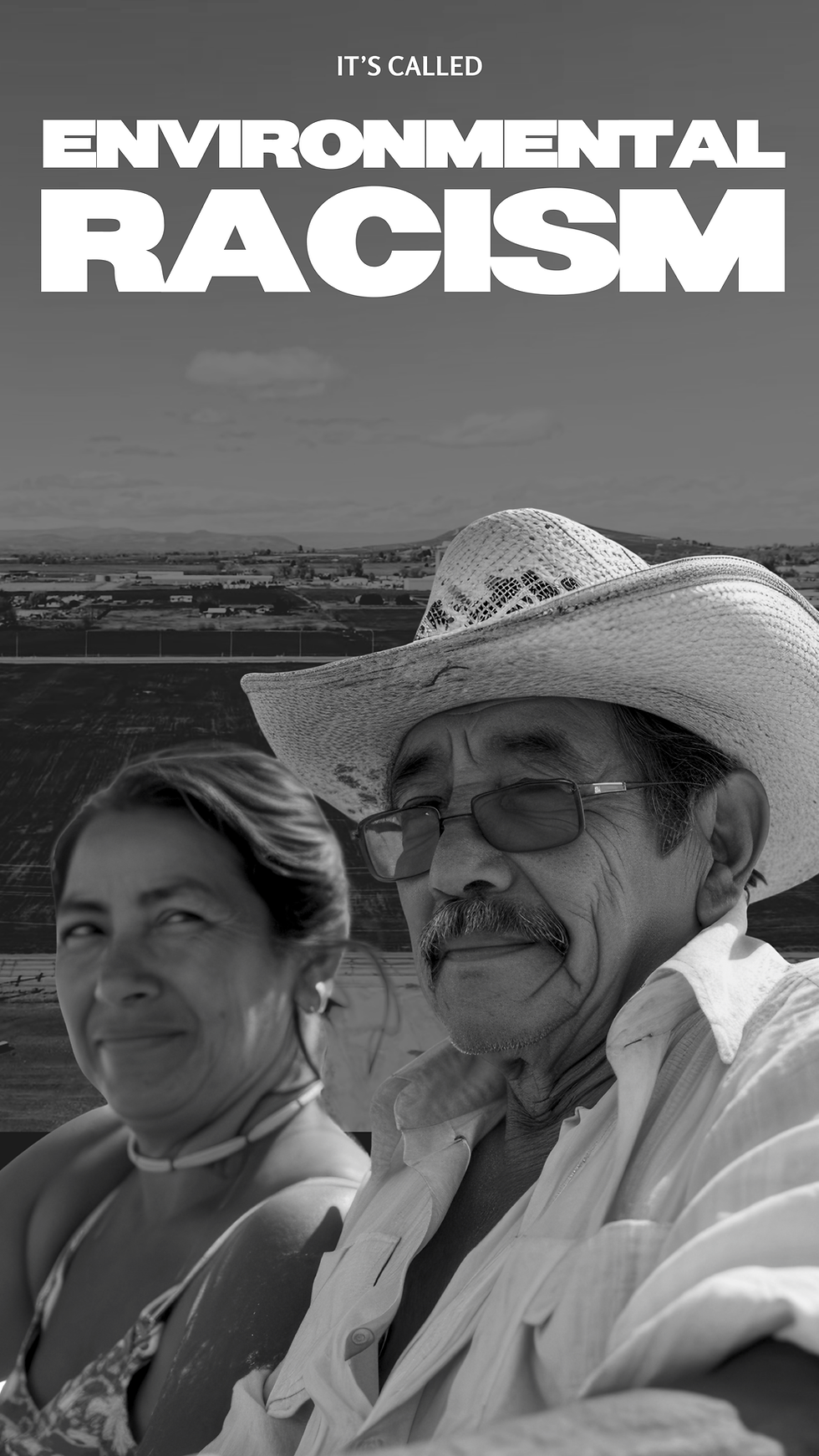
Public engagement in Tulare County followed a familiar pattern. Meetings were held during work hours, 30 miles from impacted communities, with minimal translation services, despite half of residents speaking a language other than English at home. The California Water Board inspected just 10 percent of Central Valley facilities between 2022 and 2023.
In North Carolina, hog waste facilities operated for decades in predominantly Black communities, legally spraying untreated waste into the air. A moratorium was only passed when a similar facility was proposed near a wealthy white golf resort. Hispanic Americans are nearly three times as likely as white Americans to live in communities with failing air quality grades.
Research has documented that children living near areas of heavy pesticide application are 37 percent more likely to receive diagnoses of autism spectrum disorder or developmental delay. Prenatal exposure to organophosphate pesticides, the kind used widely in Yakima Valley orchards, has been linked in peer-reviewed studies to increased risk of autism, ADHD, and reduced cognitive function. Farm workers in the United States have an average life expectancy of 49 years. The national average is 78.
A 29-year gap.
Jean Mendoza has watched this pattern play out her entire career. I asked her directly, if this facility were proposed in Zillah, in Selah, in Prosser, do you think we would be having this conversation?
Her answer was immediate.

“No, we would not. Several years ago, there was a proposal in the upper valley to take bio solids from the Yakima wastewater treatment plant and apply them as fertilizer to the cropland in the upper valley. People got together and said, no, we don’t want this stuff in our neighborhood. And they stopped it. So it’s very obvious that we’re kind of a dumping ground in the lower valley for things other people don’t want.”
The Conversation
When I posted my video, I expected some push back. I did not expect what actually happened.
The thread became a real-time document of how these conversations play out in communities like ours. Supporters of the project made genuine arguments, dairies are struggling, the waste problem is real, centralized solutions make economic sense, digesters do capture methane that would otherwise escape. Those arguments deserve respect and I tried to give them that.
What emerged over hundreds of exchanges, many on my original post, and many on threads of people who shared my post, was something I didn’t plan for. A genuine conversation about what this community is, what it deserves, and what we owe each other.
One commenter made the point that the current dairy waste system is clearly not working, nitrate contamination, open lagoons, uncontrolled emissions, and asked honestly: if not this, then what? It was the best question in the thread and it deserved a real answer.
The answer is not that digesters have no value. They do. The answer is that a digester owned by an Oregon company, approved without a full environmental study, doubled in size after approval without community notification, in a community already carrying the worst air in the state, is not a solution designed for this community. It is a profitable arrangement that uses the language of environmentalism to build something that benefits energy markets far from here while the people who live
next to it continue to breathe and drink the consequences.
There is a third option nobody is talking about. On-farm digesters owned by the farmers themselves. Distributed smaller systems that keep revenue in the valley. Nutrient recovery programs that address groundwater contamination directly. Solutions designed with this community’s input, requiring full environmental review, with enforceable local hiring commitments.
Nobody ever offered this community those options. They were handed one option, after the money was already committed, in a language many of them couldn’t read.
What Jean Wants

I asked Jean Mendoza what justice looks like to her. She thought for a moment before answering. “For me, justice is the same thing that I saw when I was in the second grade. It means everybody is treated the same. Everybody has equal rights. We know that doesn’t exist, but that’s an ideal that every one of us, in my opinion, should be striving for. When a poor single mother in the Yakima Valley calls for help, that woman should get the same attention that a rich woman gets.”
I asked her what she wants people outside the valley to understand. “The pollution that’s happening in the Yakima Valley doesn’t just impact us here. We produce a lot of greenhouse gases here and it doesn’t have to be that way. The Yakima Valley can do our part to address global warming. But we have to do it in a way that doesn’t ask the people who already carry the most to carry even more.”
And I asked her what her vision looks like for this place she has spent her life defending. “My vision of what I would like to see is the same people who go to city council meetings, who go to PTA meetings, who meet at church, come together and have a voice in what the future looks like for this community. People who want to live peaceful, gentle, productive lives. People who enjoy working the land and producing food. People who enjoy raising their children to be hopeful, optimistic, proud young people. That’s my vision. I see it happening. I just want to see more of it happening.”
What I Know Now
I grew up in this valley. I worked these fields alongside my mother, the way so many of us did. I know what it feels like to be out there before the sun comes up doing work that feeds people you will never meet. I am a storyteller and a father of six children who breathe this air. I am not an activist. I am not an expert. I am a neighbor who started asking questions and could not stop.
What I found was not a story about one facility in one small city. It was a story about a system that has been operating the same way for decades, identifying communities that are too poor, too isolated, too linguistically separated from the levers of power to push back effectively, and making decisions that benefit everyone except the people who live there.
The public comment period for the Sunnyside RNG air quality permit closes March 30th, 2026. The Yakima Regional Clean Air Agency needs to hear from real people, not just industry lawyers and county commissioners who visited Tillamook on a good day.
If you live in this valley, in Sunnyside, Grandview, Mabton, Outlook, Prosser, anywhere in the Lower Yakima Valley, your voice carries weight that no outside organization can replicate. Submit a comment at yakimacleanair.org. Call 509-834-2050. Write a letter to186 Iron Horse Court, Suite 101, Yakima, WA 98901.
Say your name. Say where you live. Say what you believe.
You don’t need legal language. You don’t need a degree. You just need to be a person who lives here and cares what happens next.
This community has been speaking for years.
It is time someone listened.
A Note on Use and Republication
This article may be shared freely for non-commercial purposes with full credit to the author. If you are a publication interested in republishing this piece in full or in part please contact Humberto Rodriguez directly at info@humbertor.com or through humbertor.com. This work was produced independently with no organizational funding or affiliation. The reporting, research, and editorial decisions are solely those of the author.
Sources
Yakima Herald-Republic — public hearing coverage, March 2026
Washington State Department of Ecology — overburdened communities report, fine particle pollution data
American Lung Association — 2025 State of the Air Report
Friends of Toppenish Creek — ammonia study, Lower Yakima Valley groundwater minority report, SEPA appeal brief
US EPA — Lower Yakima Valley groundwater management area
Capital Press — Tillamook digester spill reporting, 2019-2020
Oregon Department of Environmental Quality — Tillamook facility fines documentation
Friends of the Earth — 2024 report on Tulare County dairy digesters
Center for Food Safety — Lower Yakima Valley community advocacy documentation
USDA Rural Energy for America Program — digester loan portfolio data
Circle of Blue — Pacific Northwest agricultural contamination reporting
Pacific Ag Renewables — public documents, fact sheet, project website
Yakima Regional Clean Air Agency — draft Order of Approval, February 2026
Personal interview with Jean Mendoza, Executive Director, Friends of Toppenish Creek — March 2026
Humberto Rodriguez is a small business owner, a lifelong resident of the Yakima Valley, and the host of Behind the Scenes with Humberto Rodriguez. He is currently directing a documentary about the Sunnyside RNG project and its impact on the Lower Yakima Valley community. He can be reached at info@humbertor.com or at 509-305-1542.
Public comments on the Sunnyside RNG air quality permit are due March 30, 2026.
yakimacleanair.org | 509-834-2050 186 Iron Horse Court, Suite 101, Yakima, WA 98901

Comments